
Work started back in January!
The Greater Des Moines Botanical Garden Horticulture staff met in January 2024 to plan for this year’s holiday displays. A really big and bold bromeliad tree was part of the approach from the beginning. But how did we ‘grow’ this idea into something greater?

How did we ‘grow’ a bromeliad tree?
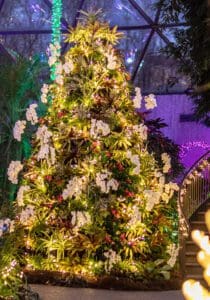
The tree is a concentric, tapering metal base that reaches 15 feet tall. Assembled outside by staff and volunteers early in November because of its size. It was partially disassembled and then brought into the conservatory in two pieces. To put all the plants in place, they had to climb aboard a boom lift which allowed us to ‘grow’ the tree, piece by piece.


Because we like to be creative at the Botanical Garden, the bromeliad tree is home to more than bromeliads. What’s a bromeliad? Read about them below! Over 300 plants fill the tree’s rings in total. Included are spider plants, orchids, Nematanthus (goldfish plant), Anthurium, ferns, philodendrons, Spanish moss and Tillandsia (air plants). All are used to fill spaces between the rings along with six varieties of bromeliads. Find each plant variety here.
The bromeliads chosen for the tree are all in the genus Neoregelia. These are tank-forming plants, meaning they form a “cup” or “vase” in the middle of the rosette. This “cup” catches water and can be a habitat for numerous insects and microorganisms. The leaves are often spotted, banded, or marbled, and some have spines along the margins. The central leaves in the rosette often turn red when the plant is getting ready to bloom.
These bromeliads can be grown as houseplants.
Bromeliads generally tolerate temperatures from 50 to 90 degrees farenheit . They need a sunny spot in the house for the best leaf color. Plant in a bark-based potting medium (the kind made for orchids) to provide a well-drained root environment. Keep the center vase or tank filled with water (rainwater is best). Allow the potting medium to dry completely between waterings.
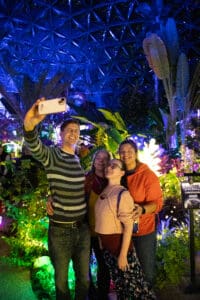
Perfect for holiday pics!
The tree occupies the space where our beloved Cuban Royal palm used to live. The palm was removed in 2023 when it grew too tall and was pressing against the roof of the conservatory. This incredible bromeliad tree will be on display until the end of this year. Come see it while you can! It’s the perfect spot for your holiday pic—make sure to grab one when you visit.